Bangle vs. Cuff Bracelet: The Difference and How to Wear Each
Bangles and cuffs can look similar in a jewelry box, but the way they sit on your wrist changes the way you wear them. One usually forms a continuous circle; the other has an opening. That small construction difference affects fit, movement, and even the combinations that feel most natural with your clothes.
Neither is the quieter choice by default. A simple bangle can become the focus of an outfit, while a fine open cuff can be almost understated. If you're deciding between the two—or wondering how to wear them together—start with the shape, not the occasion.
Bangle vs. cuff bracelet: what's the difference?
A bangle bracelet is generally a firm, continuous band worn around the wrist. A classic slip-on bangle has no opening, so it must pass over your hand before settling at the wrist. Some bangles have hinges or clasps, and jewelry labels can overlap, so always check the actual construction.
A cuff bracelet is usually a firm band with an open space between its ends. Instead of sliding over the knuckles, an open cuff is placed over the narrower side of the wrist and gently rotated into position. Cuffs can be slender or wide, smooth or textured, and open-ended does not automatically mean endlessly adjustable.
The key distinction is practical: a closed bangle needs to clear your hand; an open cuff needs to sit securely and comfortably around your wrist. Both can be worn alone or as part of a deliberate mix.

Which fits better: a bangle or a cuff?
For a slip-on bangle, consider your hand as well as your wrist
Because a closed bangle travels over your knuckles, wrist circumference alone may not tell you whether it will fit. Bring your thumb toward your palm as though you're putting on a bangle, then measure around the widest part of the compressed hand. Compare that measurement with the brand's own sizing guidance and the bangle's inner dimensions.
A well-fitting bangle should pass over your hand without forcing it and move naturally once it reaches your wrist. If it slips off when you lower your hand, it may be too large; if it cannot clear your knuckles without pressure, it may be too small. Don't assume two bangles with different shapes will fit identically simply because they share a size label.
For a cuff, focus on the wrist and the opening
An open cuff generally goes on at the side of the wrist rather than over the hand. Check the listed wrist-fit range, the opening, and where the ends rest. They should not pinch or dig into skin. A piece should feel secure without needing to be squeezed tightly each time you put it on.
Some cuffs allow a modest adjustment; others are designed to hold their shape. Repeated bending can stress the metal or finish, so follow the care and fit guidance on the individual product. For an example of a fine open design, see the Super Thin Square Cuff, which has an adjustable fit. That specific detail should never be assumed for all cuffs.
What makes one bangle look different from another?
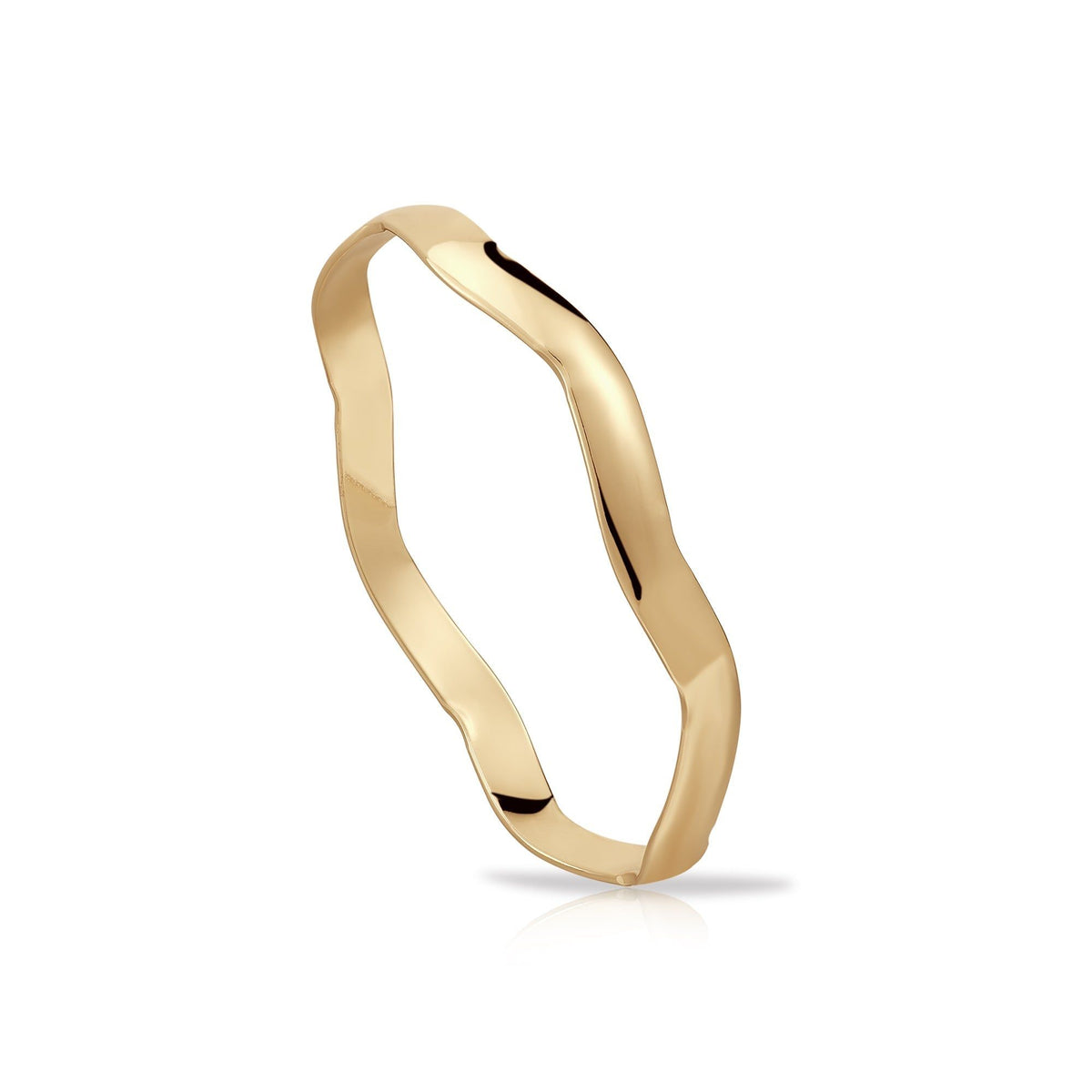
With a bangle, even a small change in surface or contour can completely alter its presence. A smooth, round band feels clean and graphic. A hammered texture catches light in a less uniform way. A wavy outline introduces movement, even when it's the only bracelet on the wrist.
Try a wavy silhouette for a point of contrast
Eklexic's Wavy Bangle has an undulating line that sits apart from a conventional round profile. It is made from brass with 14K gold or rhodium plating and a protective coating. Worn with a plain shirt or knit, its changing outline provides enough detail to stand alone. If you add a second bracelet, try something smooth rather than another piece with the same rhythm.
Choose texture when you want subtle dimension
The Hammered Bangle offers a different visual effect. Its recycled brass base is finished in 14K gold or rhodium plating, and the hammered surface makes the band less visually uniform. A silver-toned version can look particularly crisp beside black tailoring or a white shirt. A trio of matching textures can read more deliberate than a mix of unrelated shapes, and the Hammered Bangle is also offered as a set of three.

If you're already wearing textured earrings or a patterned top, one bangle may be enough. With a simpler outfit, a second bangle in a different finish can add contrast without introducing another type of jewelry.
How to choose a cuff bracelet
Open cuffs allow you to make the band's width and shape the focus. A fine cuff traces a subtle line across the wrist. A broader style can anchor the entire look, especially when it has negative space or an unexpected outline.
Let cutouts do the work
The Rectangle Cut-Out Cuff Bracelet uses a structured band interrupted by two rectangular openings. It is made from recycled brass with a protective coating and comes in gold or silver finishes. Those openings give the piece definition without adding stones or charms. Wear it alone with an open cuff or rolled sleeve, so the geometry stays visible.

Choose a fine cuff for an easy supporting line
The Super Thin Square Cuff has a much quieter profile. It is made from recycled brass with a slim square shape and an adjustable fit, in gold or silver. It can sit alongside a more substantial bracelet without repeating the same proportions, or work on its own when you want the wrist to feel nearly bare.

Don't choose solely by how a cuff looks off the body. Check how it rests against your wrist, whether the ends stay comfortable during movement, and whether its opening works with your anatomy.
How to wear a bangle bracelet on its own
One well-chosen bangle can be as decisive as a full wrist stack. Choose the bangle first, then consider what it needs around it. With a white tee and jeans, a wavy gold-toned bangle adds shape without changing the simplicity of the outfit. With tailored black trousers and a blazer, a silver-toned hammered bangle introduces texture against clean lines.
If your sleeves fall at the wrist, try pushing one back just enough to expose the band. The bracelet should be visible when you move, not hidden under fabric all day. When you're wearing a watch, leave the bangle on the opposite wrist if you prefer the two details to have separate space.
The goal isn't to make the bracelet louder; it's to make its outline legible. Sometimes that means adding less elsewhere.
How to wear a cuff bracelet without overwhelming an outfit
An open cuff works particularly well when it echoes something in your clothing. The straight sides of a rectangular cutout feel at home with a crisp shirt or structured jacket. A very fine cuff works with a soft knit and an easy neckline because it offers a subtle contrast to the fabric.
When a cuff is bold, keep adjacent accessories lighter. Small hoops or a simple chain can repeat the polished finish without competing with the bracelet. When the cuff is thin, you have more room to add a ring, a bangle or a second bracelet with a different silhouette.
Placement matters. A cuff that sits at the narrowest part of the wrist reads differently from one worn farther up the forearm. Always follow the item's intended fit, and don't force a position simply for the photograph.
Can you stack bangles and cuffs together?
Yes, but combining the two works best when each has a clear role. Start with the piece you want people to notice. If that's a cut-out cuff, add one narrower bangle or keep the other wrist bare. If a wavy bangle is the focus, a fine square cuff can act as a quiet counterpoint.
Try one of these approaches:
- One strong shape, one fine line: pair a statement cuff with a slim bangle, or reverse the balance.
- Same finish, different texture: place a smooth gold-toned cuff near a textured gold-toned bangle, provided they sit comfortably.
- Different finishes, shared geometry: use a silver bangle and a gold cuff that both have clean edges, so the finish contrast feels considered.
- Different wrists: keep a bangle on one side and a cuff on the other when the pieces rub or compete at the same wrist.
Bracelets move. Hard surfaces can touch and scratch one another, especially in a tight stack. If two pieces constantly collide, separate them rather than forcing the combination. For ideas focused specifically on building several bracelet layers, read Eklexic's guide to stacking gold bracelets. This article focuses on construction and choosing between bangles and cuffs, not repeating general stacking advice.
Gold or silver: do the finishes have to match?
No. The most useful question is whether the pieces have compatible shapes and visual weight. A warm gold-toned open cuff can work with a cool silver-toned bangle when one is substantial and the other is more restrained. You can also repeat either finish in a ring or earrings, but nothing needs to match exactly.
Metal color doesn't establish metal composition. Many Eklexic bangles and cuffs use brass with gold or silver-toned finishes, while specific pieces may have different coatings or bases. Read the individual listing instead of assuming every gold-colored bangle is solid gold or every silver-colored cuff is sterling silver.
If you're experimenting with both finishes across your jewelry wardrobe, our guide to wearing gold and silver together expands on that cross-category approach.
Three outfits, three different approaches
Denim and an open white shirt
Choose one bangle with an interesting line, such as the Wavy Bangle. Keep the neckline open and the earrings simple. The bracelet becomes a detail you notice when you reach for your bag or turn a page—not a piece that demands a matching set.
Workwear with a clean sleeve
Pair a Rectangle Cut-Out Cuff with a dark jacket and plain top. Roll the sleeve enough to reveal the cutouts, and leave extra bracelets off the same wrist. The shape adds definition without needing a pendant or embellished earrings.
A simple evening dress
Try a hammered bangle as the only wrist detail, especially with a dress that already has a distinctive neckline. Alternatively, wear the fine square cuff beside a ring in a similar finish. In either case, consider where the eye should land and remove anything that obscures that choice.
What to check before buying a bangle or cuff
Construction. Is it a full slip-on circle, hinged bangle, or open cuff? The answer affects how you put it on.
Fit. A slip-on bangle needs to pass your hand. A cuff needs to fit your wrist and opening comfortably. Check the product-specific dimensions and guidance; don't rely on labels such as one-size-fits-all.
Material and finish. Check the base metal, plating and any protective coating. The appearance of a finish alone won't tell you what lies beneath it.
Comfort. Pay attention to edge shape, weight and whether adjacent pieces collide. A piece is only versatile if you're comfortable wearing it.
Care. Remove plated jewelry before swimming, showering or applying products directly onto it. Wipe gently with a soft, dry cloth after wear and store pieces separately to limit rubbing. Follow the exact care guidance for the item rather than using abrasive cleaners.
Frequently asked questions about bangles and cuffs
Is a cuff bracelet the same as a bangle?
Not usually. A classic bangle is a continuous band; a cuff has an opening. Some hinged bangles and open bangles blur the terminology, so look at construction before buying.
Can I put a closed bangle on from the side of my wrist?
No, not unless it opens with a hinge or clasp. A closed slip-on bangle must pass over the hand. If it doesn't, check sizing instead of forcing it.
Can an open cuff be adjusted every day?
Don't assume so. Some designs allow a modest adjustment for an initial fit, but repeated bending can weaken the metal or affect the finish. Follow the product's instructions.
Can I wear a bangle and cuff on the same wrist?
Yes, if they fit well and don't cause uncomfortable rubbing. Use different proportions, or separate them onto different wrists if their surfaces hit each other.
Should a bangle move on my wrist?
Some movement is normal. It should not pinch, slip over your hand unintentionally or feel distracting during everyday activities. Check the maker's sizing guidance.
Do I need matching earrings or a necklace?
No. A single wrist piece can finish an outfit. If you want to coordinate, repeat a shape or metal finish rather than buying a matching set by default.
Choose the shape you will actually wear
The bangle-versus-cuff decision is less about rules than about how each piece fits into your day. Choose a continuous band when you want a clean line and comfortable movement. Choose an open cuff when you want a different fit or a more defined shape. Either can become the piece you reach for first.
Start with the Wavy Bangle or Hammered Bangle, explore the Rectangle Cut-Out Cuff Bracelet and Super Thin Square Cuff, or browse Eklexic bangles to compare designs in one place.